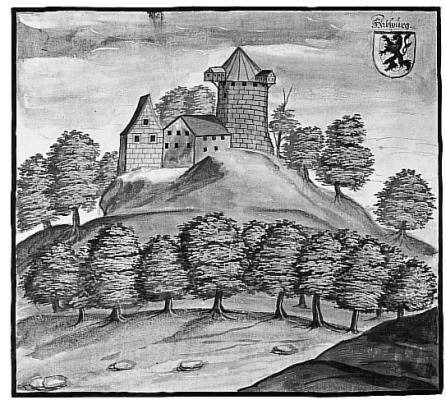
For more than five centuries, the House of Habsburg was Europe's foremost ruling family, and its influence reached well into the twentieth century — a remarkable run for a dynasty that began in decidedly republican Switzerland.
Around 1020, Count Radbot built Habsburg Castle in Aargau, and for nearly two and a half centuries the family remained a regional power among many, holding lands but no special claim to greatness. That changed in 1273, when the German prince-electors, wary of choosing anyone strong enough to threaten their own independence, settled on the comparatively obscure Count Rudolf as King of Germany. It proved a serious miscalculation on their part: Rudolf used the position to seize the duchies of Austria and Styria from a rival, and Habsburg holdings shifted decisively eastward, from Switzerland toward the lands that would remain the family's core for the next six hundred years.
The fifteenth century saw the Habsburgs consolidate their grip on the imperial title itself. From the election of Albert II in 1438, the crown of the Holy Roman Empire passed to a Habsburg in nearly every election for the next 370 years — not because the title was legally hereditary, but because the family became extraordinarily skilled at the political work of securing re-election, generation after generation. Maximilian I, who took the throne in 1493, pushed the family's fortunes further still through marriage rather than war: his own match with Mary of Burgundy brought the wealthy Low Countries into Habsburg hands, and the marriages he arranged for his grandchildren brought Spain, Bohemia and Hungary into the family's orbit in turn.
By 1521 the inheritance had grown too vast to govern as one, and it was split between two brothers. Charles V took Spain, the Low Countries and the family's Italian and American possessions; his brother Ferdinand I took Austria, Bohemia and Hungary, along with the imperial title. It is Ferdinand's branch, the Austrian Habsburgs, whose story runs through the rest of this history — the line that would rule from Vienna, strike the coins in this collection, and hold the imperial crown almost without interruption until the office itself ceased to exist.
The sixteenth and seventeenth centuries tested the dynasty severely. The Protestant Reformation split the empire's territories along religious lines, and the Habsburgs, as the empire's Catholic rulers, found themselves at the center of the resulting conflict. That tension exploded in 1618, when an attempt to impose religious uniformity on Bohemia triggered the Thirty Years' War — three decades of conflict that devastated much of Central Europe before the Peace of Westphalia in 1648 finally brought it to a close, at the cost of formally recognizing that real power now rested with the empire's individual states rather than the emperor.
The decades after Westphalia brought a different kind of challenge: the Ottoman Empire's push into Central Europe, which reached its height with the great siege of Vienna in 1683. The city held, with the help of a relieving army, and the following decades saw the Habsburgs go on the offensive, steadily reclaiming Hungary and expanding their territory eastward under Leopold I, whose 47-year reign was one of the longest in the family's history.
The eighteenth century brought a crisis of a different kind: the male line simply ran out. When Emperor Charles VI died in 1740 without a son, the succession fell to his daughter Maria Theresia — an outcome he had spent years trying to secure diplomatically through the Pragmatic Sanction, and one that was immediately contested by rival claimants the moment he died. Maria Theresia fought off the challenge, went on to reform the empire's administration, education and military more thoroughly than any predecessor, and through her marriage to Francis of Lorraine founded the House of Habsburg-Lorraine — a new formal name, though the Habsburg identity and tradition continued unbroken. Her taler, its design frozen at her death in 1780, would go on to become one of the most widely circulated trade coins in history.
The empire that had lasted a thousand years did not survive contact with Napoleon. As French power reorganized western Germany in 1806, Emperor Francis II — who had already, two years earlier, pre-emptively declared himself hereditary Emperor of Austria — recognized that the old imperial title no longer described any real political reality, and dissolved the Holy Roman Empire by his own decree. The family did not disappear with it; they simply continued as rulers of Austria, and after 1867, as co-rulers of the new dual monarchy of Austria-Hungary.
The final chapter belongs to Francis Joseph I, who came to the throne at eighteen amid the revolutionary upheavals of 1848 and went on to reign for 68 years — longer than any other Habsburg. His extraordinarily long rule absorbed military defeats, the reorganization of the empire into Austria-Hungary, and a string of personal tragedies, before ending in the middle of the First World War, a conflict set in motion by the assassination of his own designated heir. When the war ended in 1918, so did the monarchy: the last Habsburg emperor, Charles I, was forced from power, and a dynasty that had shaped European history for nearly a thousand years continued only as a family of private citizens.